
ELLEVATION EDUCATION, fall 2024 - Spring 2025
How I Reframed an Existing Model to Bridge Converging Use Cases
When my team set out to build a family-facing extension of Ellevation Forms, we expected it to be a seamless adaptation. But early discovery revealed that educators think of “form progress” in staff vs. family forms in completely different ways. That gap in understanding exposed a larger design challenge: one that required reframing not just the interface, but the product’s mental model itself.
How I Reframed an Existing Model to Bridge Converging Use Cases
When my team set out to build a family-facing extension of Ellevation Forms, we expected it to be a seamless adaptation. But early discovery revealed that educators think of “form progress” in staff vs. family forms in completely different ways. That gap in understanding exposed a larger design challenge: one that required reframing not just the interface, but the product’s mental model itself.
Reconsidering the M in MVP
In Fall 2024, my team at Ellevation was progressing on our longstanding effort to build a family-facing product that integrates into the existing Forms offering - a program management platform for educators of English learners (ELs). We believed families could easily engage through an extension of existing workflows.
Reconsidering the M in MVP
In Fall 2024, my team at Ellevation was progressing on our longstanding effort to build a family-facing product that integrates into the existing Forms offering - a program management platform for educators of English learners (ELs). We believed families could easily engage through an extension of existing workflows.
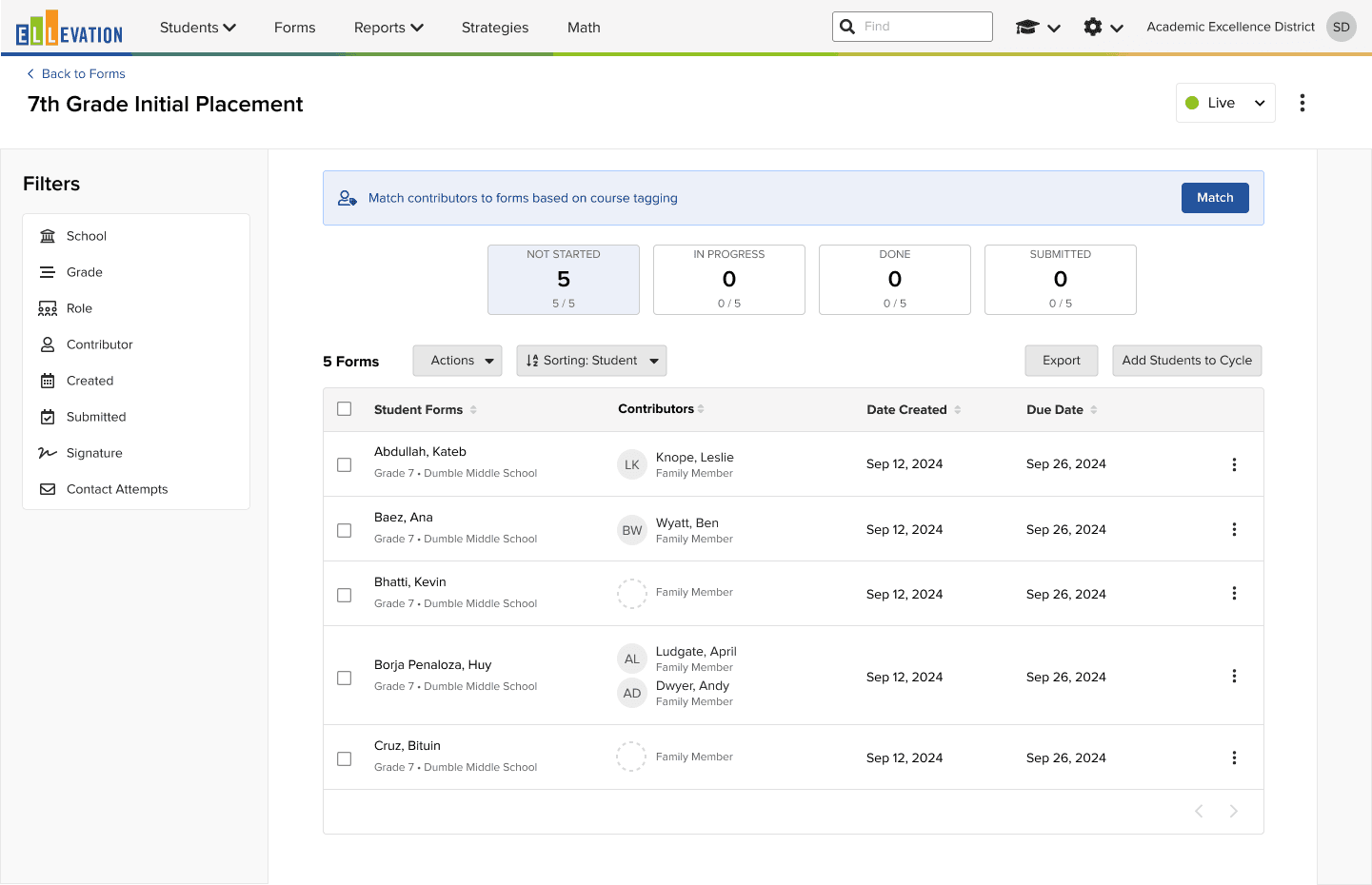
An Ellevation Forms cycle for a 7th grade Initial Placement Letter
An Ellevation Forms cycle for a 7th grade Initial Placement Letter
In the spirit of building to learn, our agile team produced a proof of concept we called the SVP which was a mix of Figma prototypes and in-product workarounds. I spent much of the quarter testing and iterating upon this SVP with internal experts and external partners to learn about and address anticipated barriers to usage.
In the spirit of building to learn, our agile team produced a proof of concept we called the SVP which was a mix of Figma prototypes and in-product workarounds. I spent much of the quarter testing and iterating upon this SVP with internal experts and external partners to learn about and address anticipated barriers to usage.
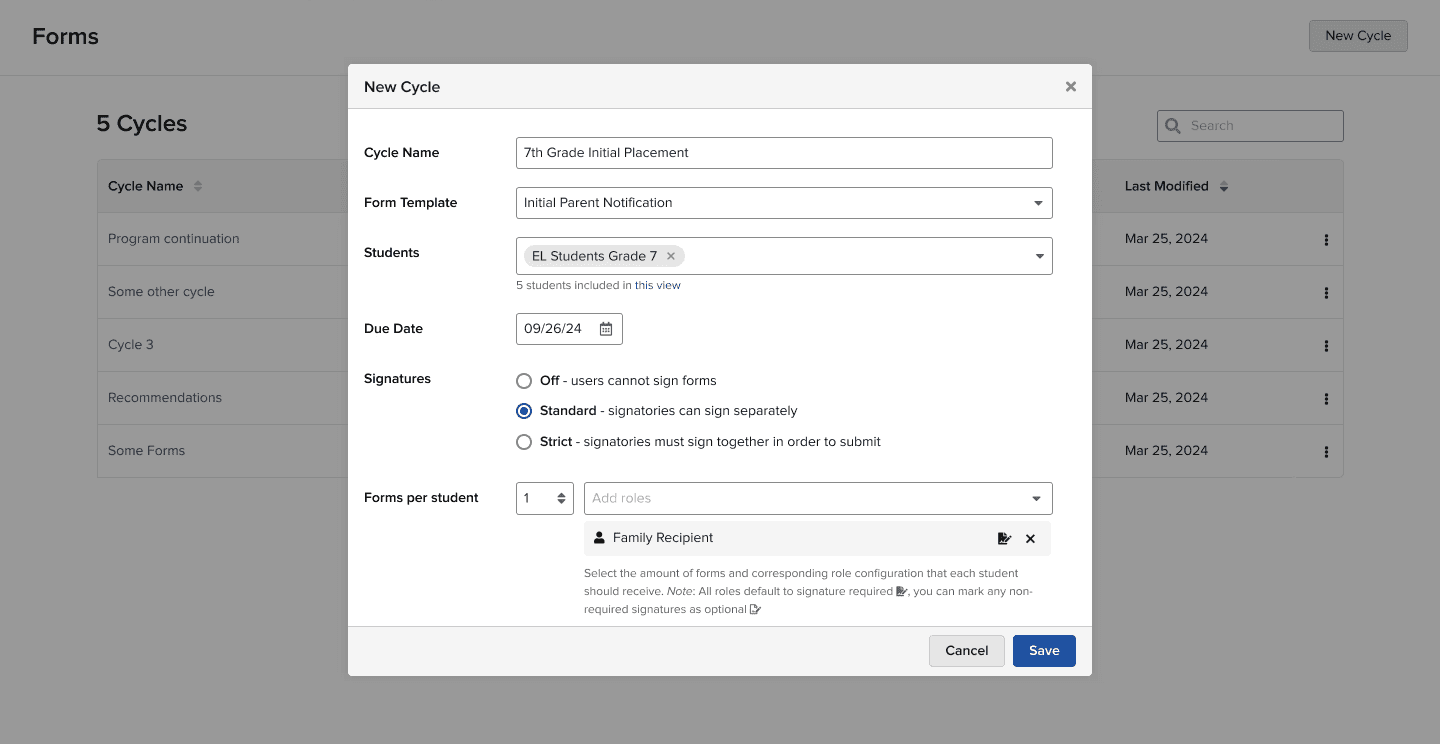
An interactive Figma prototype used for the purpose of usability testing the SVP
An interactive Figma prototype used for the purpose of usability testing the SVP
🧠 Helpful Definitions
English learner (EL): A student learning English as a second/additional language alongside their native language(s). Adjacent terms: ELLs, MLs, or EBs.
Form: a student-specific document generated from a template
Belongs to broader EL program workflows, often mandated by state/federal laws
Collects input and signatures from teachers and other key stakeholders
Contributors: individuals assigned to Forms, categorized by role (e.g. EL specialist, ML admin, math teacher)
Cycle: a group of Forms for a designated batch of students
Cycle birdseye is the primary page ML admins use to track the progress and completion of dozens to thousands of Forms
⭐ Buckets = filters at the top of Cycle birdseye that group Forms of the same status
🧠 Helpful Definitions
English learner (EL): A student learning English as a second/additional language alongside their native language(s). Adjacent terms: ELLs, MLs, or EBs.
Form: a student-specific document generated from a template
Belongs to broader EL program workflows, often mandated by state/federal laws
Collects input and signatures from teachers and other key stakeholders
Contributors: individuals assigned to Forms, categorized by role (e.g. EL specialist, ML admin, math teacher)
Cycle: a group of Forms for a designated batch of students
Cycle birdseye is the primary page ML admins use to track the progress and completion of dozens to thousands of Forms
⭐ Buckets = filters at the top of Cycle birdseye that group Forms of the same status
A Common Pain Point
A challenge of integrating into any existing product is that we have to understand how to adapt the needs of the new use case into an established mental model. Among the assumptions I tested in 25+ usability sessions was whether “Users can easily identify the state of each form and manage forms to completion.”
A Common Pain Point
A challenge of integrating into any existing product is that we have to understand how to adapt the needs of the new use case into an established mental model. Among the assumptions I tested in 25+ usability sessions was whether “Users can easily identify the state of each form and manage forms to completion.”
Unsurprisingly, the existing progress buckets were not intuitive for family use cases
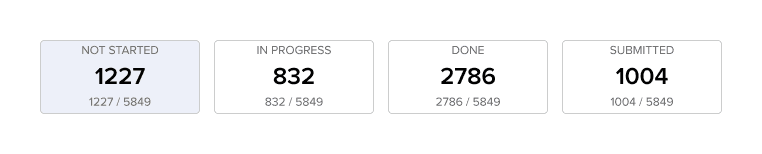
Form progress buckets
Form progress buckets
Unlike current district workflows, an essential step of family workflows is the notification itself - evidence of which is required during compliance audits. The fear of failing audits can be a sales blocker for districts.
Across four rounds of discovery, I learned that despite having sent out all form notifications to families, users lacked confidence that they completed their task and felt compelled to somehow move forms into Done or Submitted, as might be the case when they are typically overseeing a staff Cycle today.
Unlike current district workflows, an essential step of family workflows is the notification itself - evidence of which is required during compliance audits. The fear of failing audits can be a sales blocker for districts.
Across four rounds of discovery, I learned that despite having sent out all form notifications to families, users lacked confidence that they completed their task and felt compelled to somehow move forms into Done or Submitted, as might be the case when they are typically overseeing a staff Cycle today.
“Our process stops at sending because these letters don’t need to be returned back to us. Would I be able to manually move those forms into done so I know it’s completed?”
– District admin from Washington state
“Our process stops at sending because these letters don’t need to be returned back to us. Would I be able to manually move those forms into done so I know it’s completed?”
– District admin from Washington state
Along with general feedback I compiled from ~5 Partner Success Managers, my discovery takeaways proved that buckets were a major risk hindering the GTM strategy for Family Communications.
Along with general feedback I compiled from ~5 Partner Success Managers, my discovery takeaways proved that buckets were a major risk hindering the GTM strategy for Family Communications.
All Hands on Deck!
My Product and Engineering co-leads and I acknowledged this challenge went beyond the scope of just our team. Forms was an existing product with 2 other dedicated teams with their own set of risks and priorities. It was essential that our teams collaborated on any further discovery and ideation as early in the process as possible.
All Hands on Deck!
My Product and Engineering co-leads and I acknowledged this challenge went beyond the scope of just our team. Forms was an existing product with 2 other dedicated teams with their own set of risks and priorities. It was essential that our teams collaborated on any further discovery and ideation as early in the process as possible.
Enter: The Forms Team
I hosted a cross-functional ideation session in collaboration with the Forms Design Lead at our monthly onsite, which helped surface shared risks and align priorities across three product teams working on different Forms dependencies.
In small groups, our colleagues brainstormed ideas on how we might solve the riskiest challenges our teams were facing, which they narrowed down incrementally through a voting activity.
Enter: The Forms Team
I hosted a cross-functional ideation session in collaboration with the Forms Design Lead at our monthly onsite, which helped surface shared risks and align priorities across three product teams working on different Forms dependencies.
In small groups, our colleagues brainstormed ideas on how we might solve the riskiest challenges our teams were facing, which they narrowed down incrementally through a voting activity.
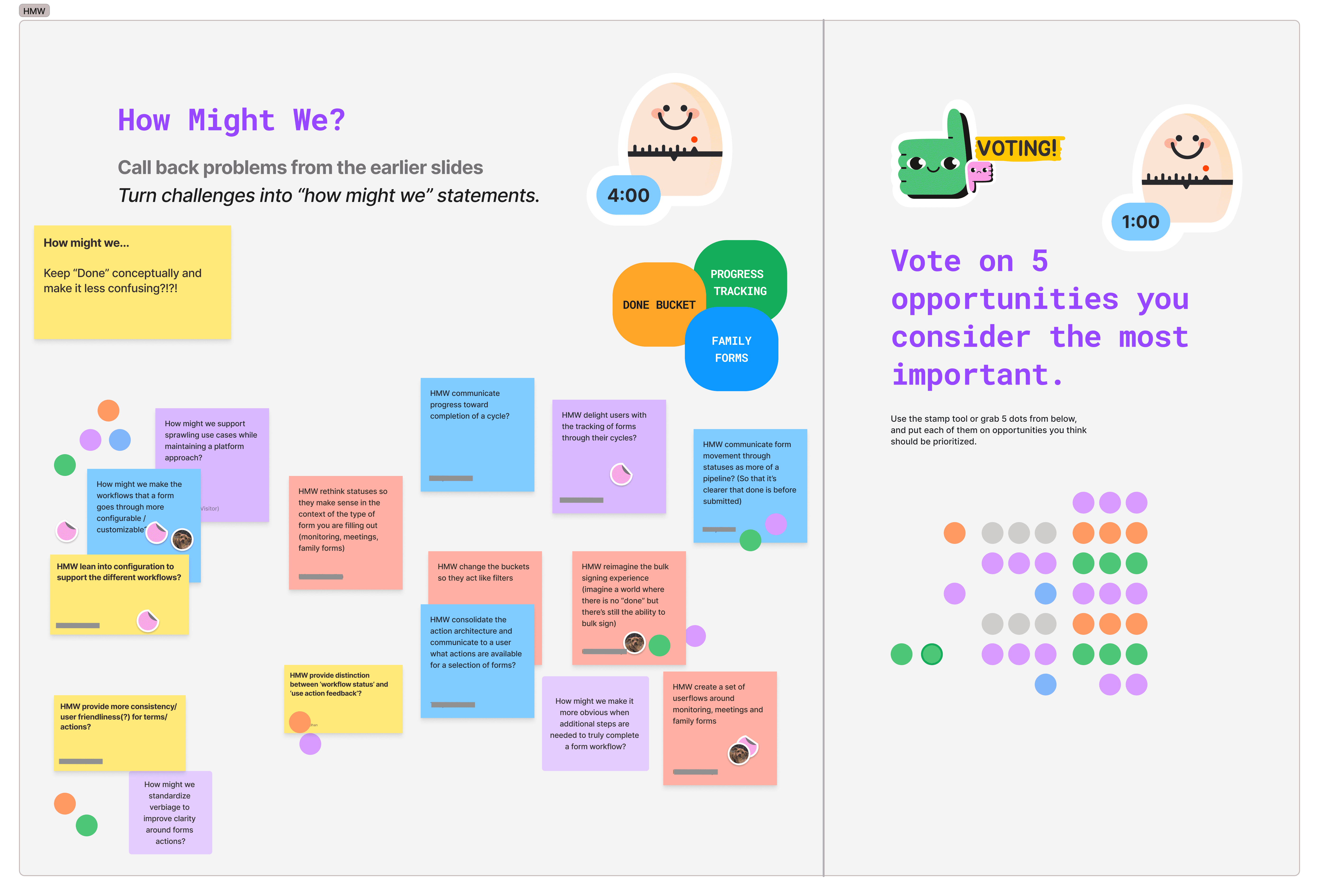
Studio-style whiteboard activity with engineering leads, product managers, and instructional content managers from 3 product teams
Studio-style whiteboard activity with engineering leads, product managers, and instructional content managers from 3 product teams
Around the same week, I led a more targeted working session with my team on The Problems with Buckets. We discussed risks that I compiled with the product manager and voted on the statements we felt were most critical to resolve.
Around the same week, I led a more targeted working session with my team on The Problems with Buckets. We discussed risks that I compiled with the product manager and voted on the statements we felt were most critical to resolve.
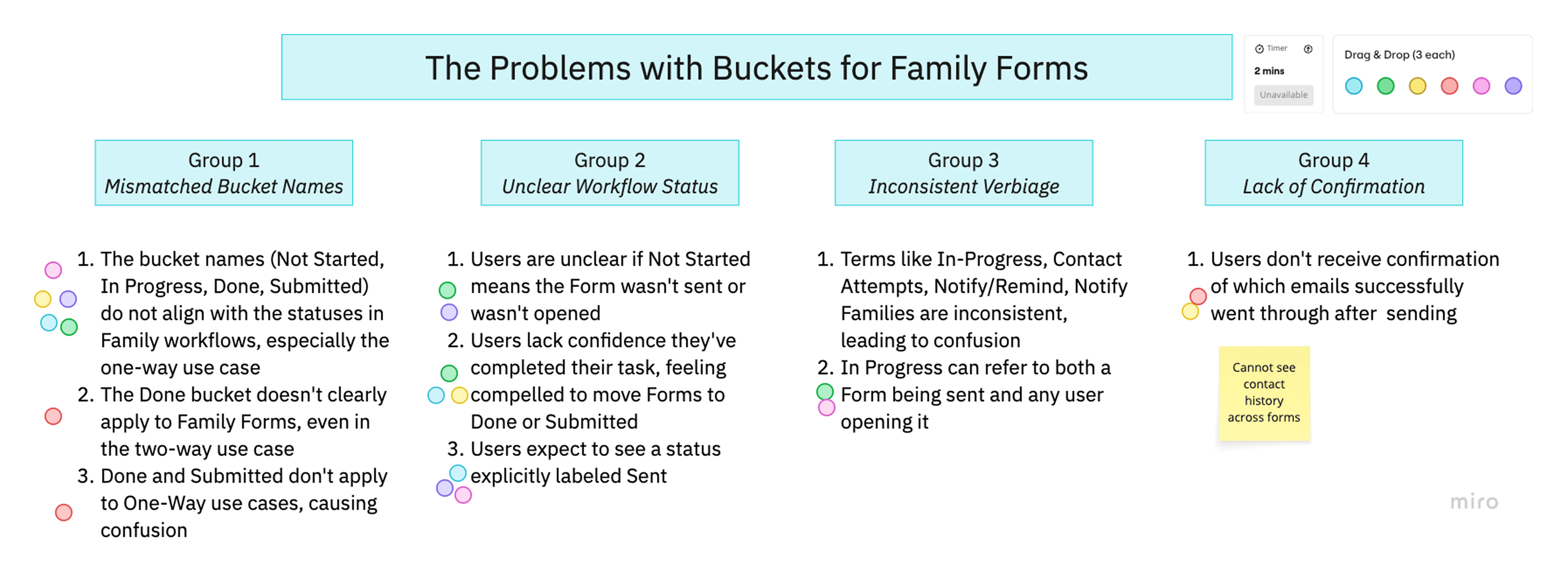
I led the team in a discussion on the most voted items, trying to understand their motivations behind prioritizing each
I led the team in a discussion on the most voted items, trying to understand their motivations behind prioritizing each
We took time at the end of the voting to ideate on our wildest ideas for solving the voted risks. Collaborating with engineers on design ideation is always unique, as they come with fresh and informed perspectives on the product that I may not have otherwise considered!
These collaborative sessions revealed that multiple teams were grappling with similar confusion around how progress was represented across use cases. This alignment gave my team collective buy-in to explore systemic changes rather than workarounds.
We took time at the end of the voting to ideate on our wildest ideas for solving the voted risks. Collaborating with engineers on design ideation is always unique, as they come with fresh and informed perspectives on the product that I may not have otherwise considered!
These collaborative sessions revealed that multiple teams were grappling with similar confusion around how progress was represented across use cases. This alignment gave my team collective buy-in to explore systemic changes rather than workarounds.
Reflecting and Reframing
At this point, you might be asking yourself: Was all this really necessary? Perhaps it wasn’t – once we identified the issue of buckets not fitting into the user’s mental model, we could have shipped a revised set of bucket titles aligned to the Family Form use case. A few customer interviews might have even validated that plan. But we wouldn’t have deeply understood the implications this would have for existing Forms, nor would we have addressed the root issue: Family Form use cases do not map one-to-one with current Form use cases.
Through repeated iteration and testing, it became clear that buckets were not the true problem to solve. Buckets communicate Form status. What users lacked was visibility into Notification Status.
Reflecting and Reframing
At this point, you might be asking yourself: Was all this really necessary? Perhaps it wasn’t – once we identified the issue of buckets not fitting into the user’s mental model, we could have shipped a revised set of bucket titles aligned to the Family Form use case. A few customer interviews might have even validated that plan. But we wouldn’t have deeply understood the implications this would have for existing Forms, nor would we have addressed the root issue: Family Form use cases do not map one-to-one with current Form use cases.
Through repeated iteration and testing, it became clear that buckets were not the true problem to solve. Buckets communicate Form status. What users lacked was visibility into Notification Status.
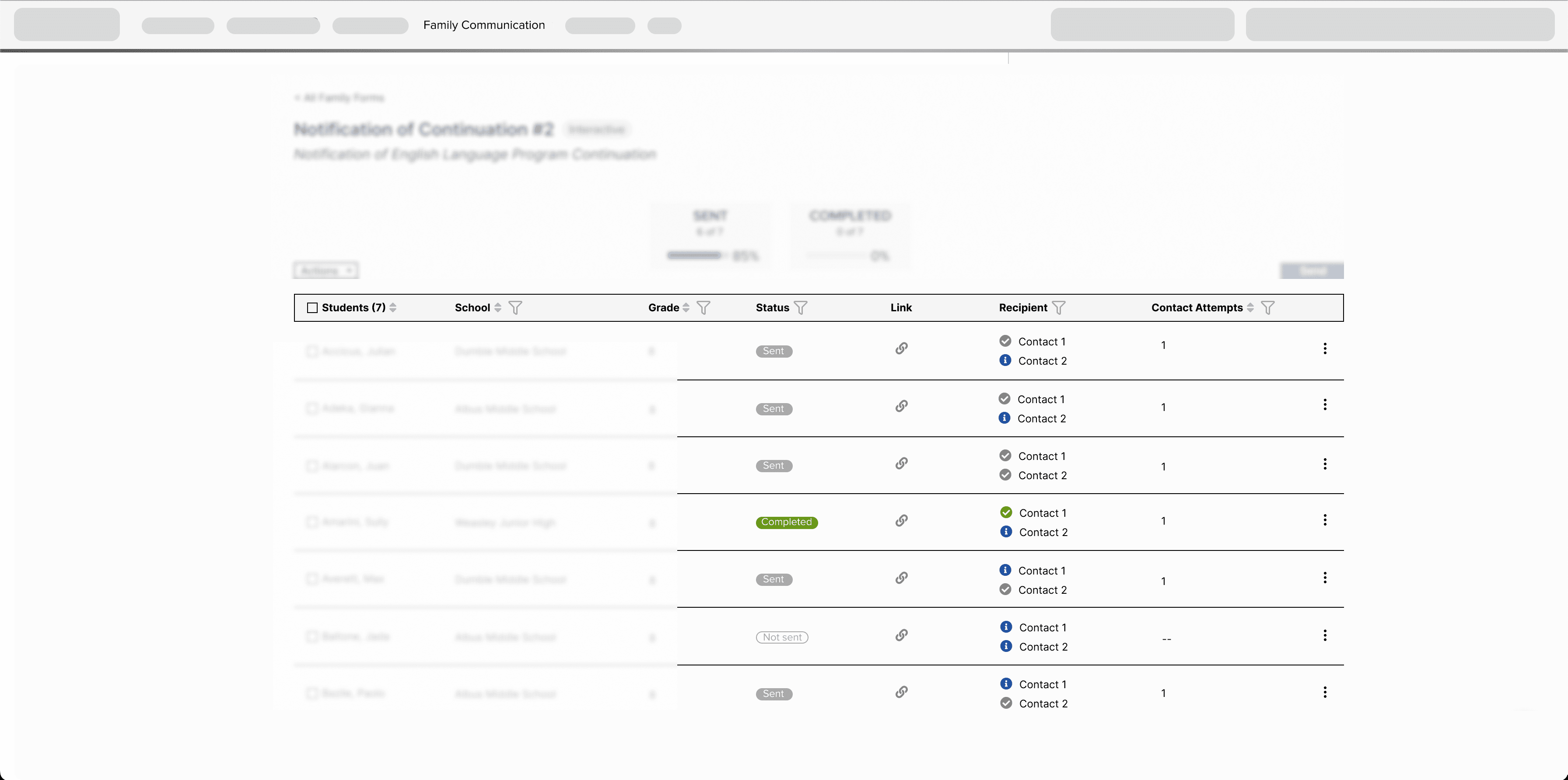
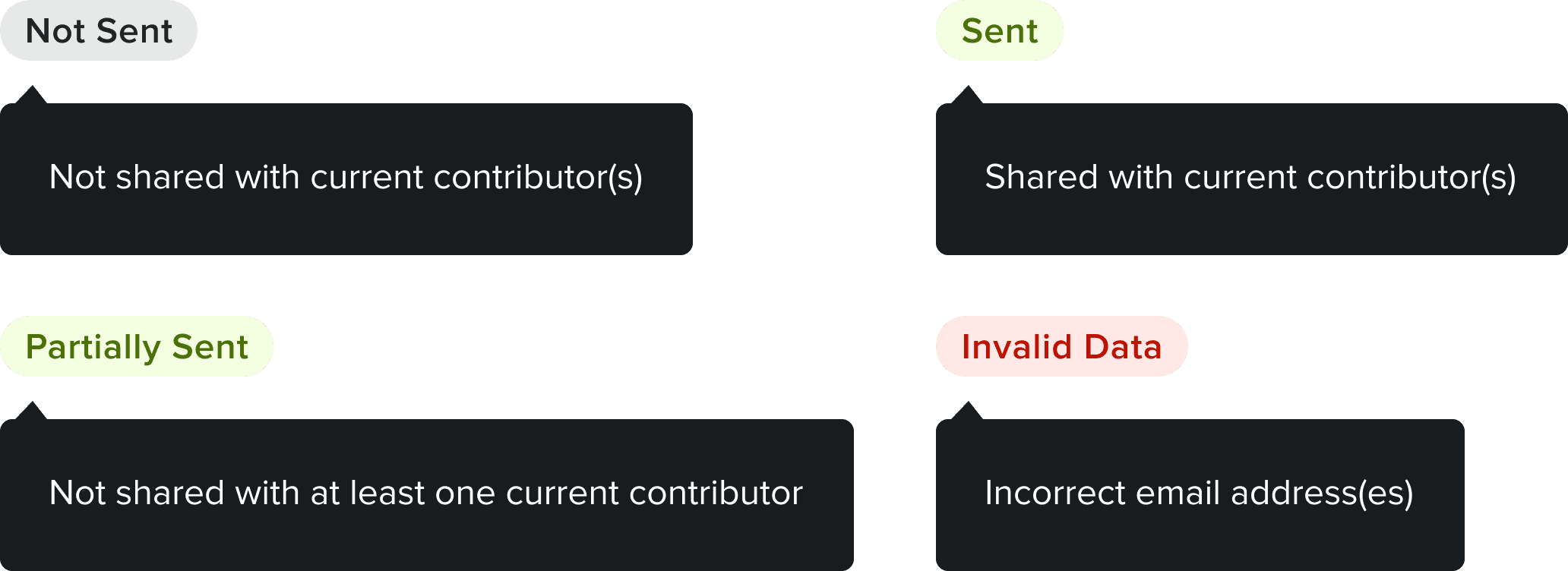
An early concept for visibility into Form notification
An early concept for visibility into Form notification
After three rounds of releasing small increments and validating the adjusted mental model, my team landed on a notification status chip, a scalable pattern to use across all Form use cases.
After three rounds of releasing small increments and validating the adjusted mental model, my team landed on a notification status chip, a scalable pattern to use across all Form use cases.
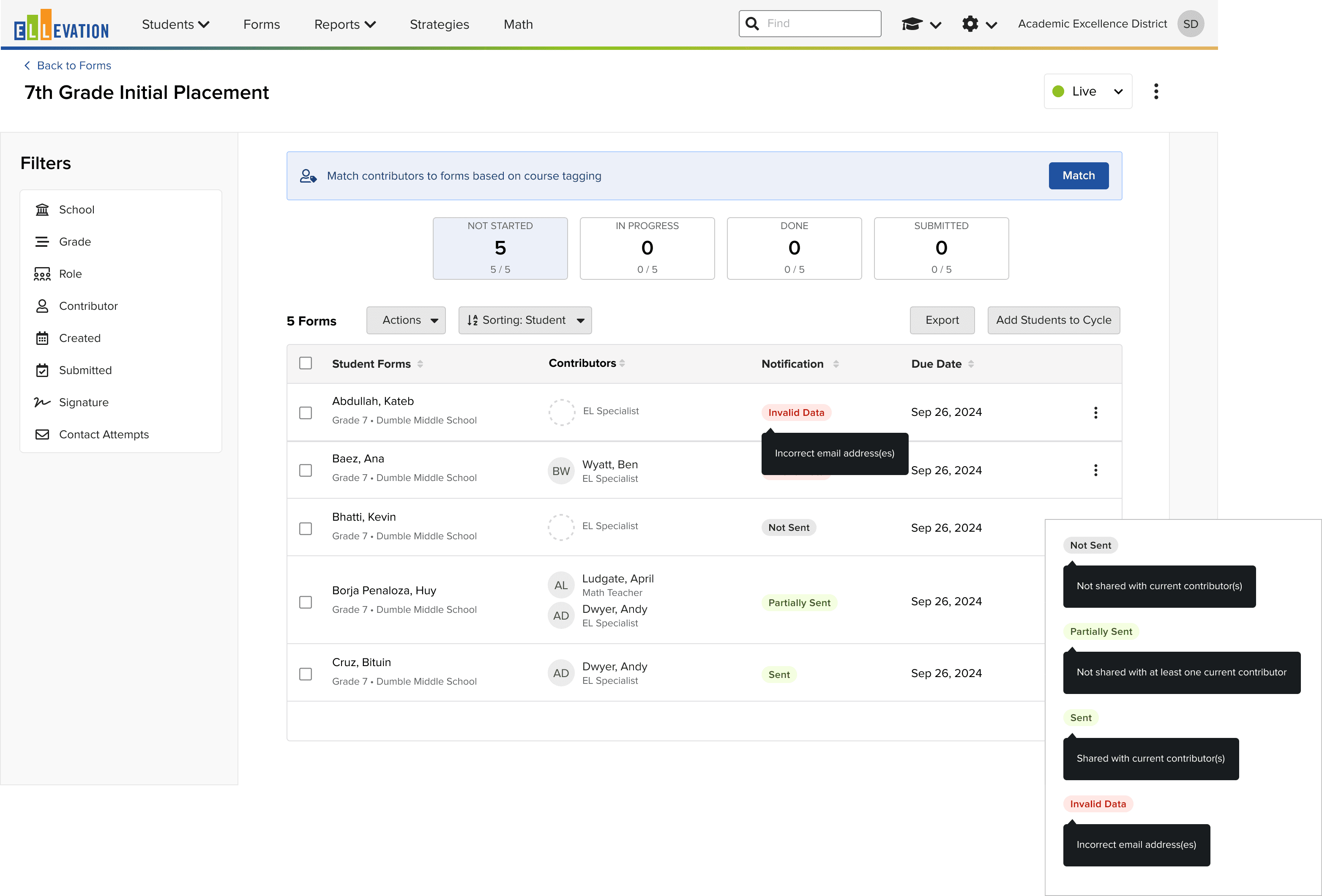
Final iteration of Notification Status chips shipped to Ellevation Forms
Final iteration of Notification Status chips shipped to Ellevation Forms
This shift allowed us to preserve the integrity of existing workflows while making the product flexible enough to support new Form scenarios. Notification chips added value for existing Form use cases and became a key metric to be leveraged on the platform’s analytic offerings. It also brought the team one step closer to proving the viability of the Family Forms SVP, enabling us to confidently release the product to early adopters. Most importantly, usability interviews confirmed that the new status chips reduced confusion and improved task completion for Ellevation’s users.
This shift allowed us to preserve the integrity of existing workflows while making the product flexible enough to support new Form scenarios. Notification chips added value for existing Form use cases and became a key metric to be leveraged on the platform’s analytic offerings. It also brought the team one step closer to proving the viability of the Family Forms SVP, enabling us to confidently release the product to early adopters. Most importantly, usability interviews confirmed that the new status chips reduced confusion and improved task completion for Ellevation’s users.